
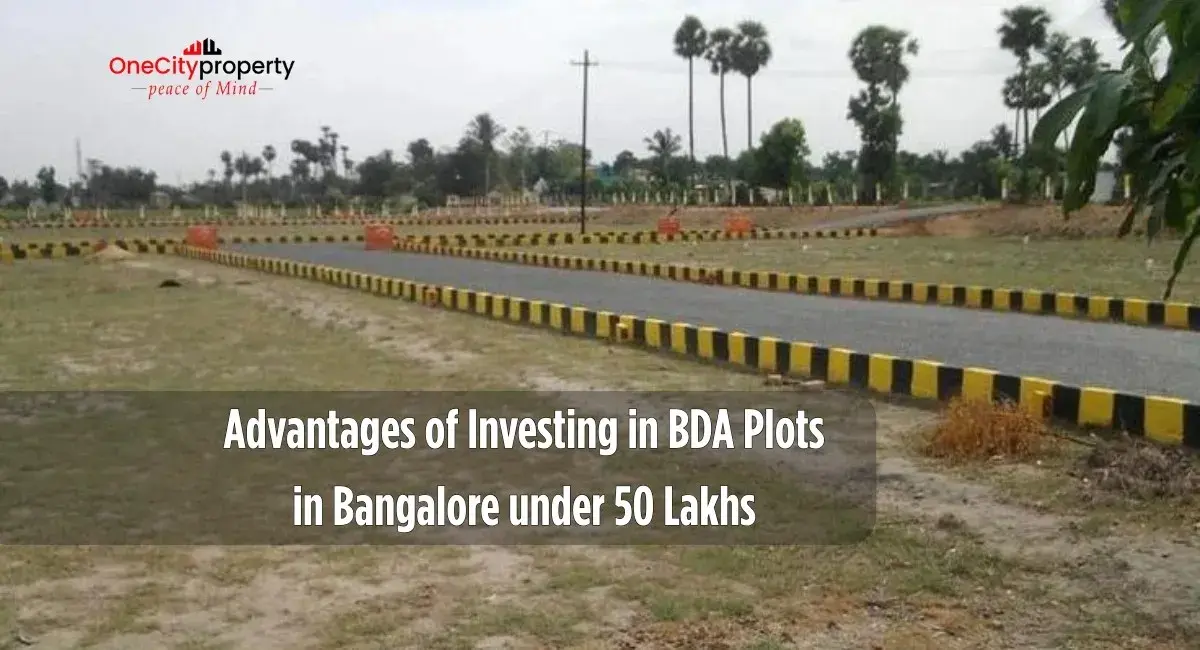
BDA-Approved Plots in Bangalore Under 50 Lakhs: Benefits

Quick answer: BDA-approved plots carry A-Khata and clear title from a statutory authority, which makes them materially easier to finance and resell than private layouts. Availability under 50 lakh is limited and generally on resale in outer BDA layouts. On any BDA resale, confirm the allotment letter, possession certificate and absolute sale deed.
Published: 14 May 2025 · Updated: 1 June 2026 · By L K Monu Borkala, CEO & Founder, OneCity Property — 15 years of property consultancy experience and over 20 years in marketing and management at OneCity Technologies Pvt. Ltd.
In 20 years of working Bangalore real estate, every plot transaction that became a problem, legal dispute, bank loan rejection, building plan stuck in approval, had one thing in common: the plot was not BDA-formed. Every transaction that was clean from day one had another common thread: it was. BDA-approved plots are not just a safer option. For buyers in Bangalore who want a plot under ₹50 lakhs, they are the benchmark against which every other option should be measured.
This guide explains what makes BDA plots fundamentally different from other plot types, where sub-₹50 lakh BDA inventory actually exists in 2026, how the BDA e-auction process works, what you can build, and the specific appreciation data that makes the case for this investment.
What Makes BDA-Approved Plots Categorically Different From Other Plot Types?
The Bangalore Development Authority acquires land, develops it into a planned residential layout, roads, drainage, parks, utility corridors, and then either allots the sites directly to individuals through scheme or e-auction, or hands the developed layout to BBMP for ongoing maintenance. This process creates five advantages that no other plot type in Bangalore can fully replicate:
1. Government-anchored title chain:The BDA Allotment Letter is a government document issued by a statutory authority. It is the cleanest title anchor in Bangalore real estate, no agricultural land to convert, no village map ambiguity, no gram panchayat jurisdiction risk. The ownership chain starts with the state government, not with a private party.
2. Automatic BBMP A-Khata eligibility:BDA-formed sites in areas under BBMP jurisdiction carry BBMP A-Khata from formation. There is no CMC legacy Khata issue, no B-Khata risk, no betterment charge requirement to migrate from gram panchayat records. A-Khata follows the BDA Allotment Letter as a matter of process.
3. Bank loan eligibility across all lenders:SBI, HDFC, ICICI, Axis Bank, and every scheduled bank lend on BDA-formed plots without requiring a property lawyer's legal opinion letter as a condition. The approval process is clear because the title is clear. Revenue sites, DTCP plots, and Gramathana properties face selective lending, BDA does not.
4. No DC conversion required:BDA sites are classified as residential from the date of formation, there is no agricultural land classification to convert. The DC conversion step that adds cost, time, and documentation risk to revenue site purchases simply does not apply.
5. Building plan approval is procedurally clean:BBMP building plan approval for a BDA-formed site follows a standard process. The jurisdictional authority is clear (BBMP), the land use classification is residential, and the BDA Allotment Letter satisfies the ownership proof requirement. Projects built on BDA sites have cleaner OC acquisition histories than comparable projects on revenue land.
Where Do Sub-₹50 Lakh BDA Plots Actually Exist in 2026?
Direct BDA allotment at sub-₹50 lakh prices is rare, BDA's current scheme pricing in established layouts reflects market rates. The sub-₹50 lakh BDA plot in 2026 is primarily a resale story, with specific locations where older BDA-allotted sites from 1970s - 2000s schemes are transacting below this threshold. Here is the realistic location map:
Kengeri and Sir MV Layout (Ullal)
Kengeri is one of the oldest BDA-developed zones in southwest Bangalore, with allotments dating to the 1970s - 1990s. 20×30 sites (600 sq ft) in Kengeri BDA layout and the adjacent Sir MV Layout (Ullal area) are available in resale at ₹30 - ₹45 lakh. These are BDA-formed sites with clean Allotment Letters, the lower price reflects distance from the current premium commercial zones rather than any documentation risk. The Yellow Line metro connection to this belt via Kengeri station makes it more accessible than it was five years ago.
Nagarabhavi
Nagarabhavi has BDA-formed layout streets that produced allotments in the 1980s - 2000s. 20×30 and some 30×40 sites are available in resale at ₹32 - ₹50 lakh depending on road width and proximity to main roads. The area sits on Mysore Road, with NICE Road connectivity and the Purple Line metro extension in long-term planning discussions. Good for buyers who want southwest Bangalore access, RVCE, RV College, and Rajarajeshwari Nagar are adjacent employment and social infrastructure anchors.
Hennur
Hennur has older BDA layout allotments from the late 1990s - early 2000s in its inner residential streets. 20×30 sites in BDA-formed Hennur are available at ₹38 - ₹50 lakh. The location has been transformed by Manyata Tech Park proximity and the Blue Line metro corridor (Nagawara and Thanisandra stations are within 3 - 5 km). Hennur BDA sites at sub-₹50 lakh represent the best combination of BDA title quality and North Bangalore metro-era demand growth.
Visvesvaraya Layout and Horamavu
These northeast Bangalore BDA layouts from the 1990s - 2000s have 20×30 and 30×40 sites at ₹35 - ₹52 lakh in resale. The Blue Line Phase 2B airport corridor passes through the Krishnarajapura belt adjacent to these areas, the KR Puram and Horamavu micro-markets are seeing appreciation pressure from metro proximity. For buyers comfortable with 30 - 45 minute commutes to the city core, Visvesvaraya Layout BDA sites represent undervalued BDA inventory.
BDA Direct Scheme, E-Auction Route
BDA periodically conducts e-auctions for sites in its layouts, including premium locations like JP Nagar, Banashankari, and HSR Layout. Base prices in e-auctions are typically 20 - 30% below current market rates. The sub-₹50 lakh e-auction opportunity exists primarily for smaller 20×30 sites in peripheral BDA layouts, not in the premium zones, where base prices for even small sites now exceed ₹50 lakh.
E-auction process: ₹4 lakh EMD per site → win bid → pay 25% of bid (minus EMD) within 72 hours → receive sale confirmation → pay remaining 75% within 45 days of allotment letter → complete registration. TDS of 1% applies for properties above ₹50 lakh. The BDA e-auction portal is housing.bdabangalore.org, upcoming auctions are announced on this portal.
What Can You Build on a BDA-Approved Plot Under ₹50 Lakhs?
A BDA-formed site in BBMP jurisdiction follows BBMP's building regulations under the Revised Master Plan 2031. The applicable FAR (Floor Area Ratio) depends on plot size:
| Plot Size | Dimensions | FAR | Max Built-up | Typical Development |
|---|---|---|---|---|
| 600 sqft | 20×30 | 2.25 | 1,350 sqft | G+2 with one unit per floor |
| 1,200 sqft | 30×40 | 2.25 | 2,700 sqft | G+2 with 2 units per floor |
| 1,500 sqft | 30×50 | 2.5 | 3,750 sqft | G+2 or G+3 with multiple units |
The redevelopment math for a 20×30 BDA site purchased at ₹38 lakh (Kengeri or Nagarabhavi):
- Land cost: ₹38,00,000
- Construction of G+2 (1,350 sqft at ₹1,800 - ₹2,200/sqft): ₹24 - ₹30 lakh
- Total investment: ₹62 - ₹68 lakh
- Rental income from 3 units (G+1+2) at ₹10,000 - ₹12,000 per unit: ₹30,000 - ₹36,000/month
- Gross annual yield on total investment: 5.3 - 6.3%
- Resale value of completed G+2 (3 independent units) in Kengeri/Nagarabhavi area: ₹80 - ₹95 lakh
The redevelopment ROI is the primary investment case for sub-₹50 lakh BDA plots. The clean title chain means building plan approval is clear, OC can be obtained, and completed units carry full bank-loan-eligible resale value.
BDA Plot vs DTCP-Approved Layout, What Is the Actual Difference for an Investor?
Both are legitimate plot types for investment. The comparison matters for buyers deciding between a BDA resale at ₹40 lakh in Kengeri versus a DTCP-approved developer layout at ₹42 lakh on Sarjapur Road outer stretch.
| Factor | BDA Plot (Resale) | DTCP Developer Layout |
|---|---|---|
| Title anchor | Government (BDA Allotment Letter) | DC conversion + layout approval |
| Khata | BBMP A-Khata (automatic) | E-Khata (must verify) |
| Bank loan | All banks, no conditions | Most banks with layout approval |
| DC conversion needed | No | Already done (verify) |
| Building plan approval | BBMP, clear | DTCP/local body, varies |
| Location | Within established BBMP city limits | Usually peripheral (10 - 30km from city) |
| Appreciation driver | Scarcity (no new BDA supply) | Infrastructure arrival |
| Price | ₹30 - ₹50L for 20×30 in outer BDA areas | ₹38 - ₹50L for 1,200 sqft in growth belt |
The core distinction: BDA plots are in established areas within BBMP limits, scarcity of supply drives appreciation. DTCP layouts are in growth corridors, infrastructure arrival drives appreciation. Both are legitimate but serve different investment thesis: BDA for lower risk, slower appreciation; DTCP in growth corridor for higher upside with timeline risk.
What Is the Appreciation Track Record for BDA Plots in Bangalore?
BDA plot appreciation in established layouts is driven by land scarcity, BDA cannot form new layouts in already-developed areas, and the existing supply is finite. The data:
- Banashankari BDA layout (30×40 site):₹18 lakh in 2010 → ₹90 - ₹1.1 crore in 2026. Approximately 600% in 16 years.
- HSR Layout BDA site:₹22 lakh in 2012 → ₹85 - ₹1.1 crore in 2026. Approximately 400% in 14 years.
- Kengeri BDA layout (20×30):₹8 lakh in 2010 → ₹38 - ₹45 lakh in 2026. Approximately 475% in 16 years.
- Hennur BDA layout:₹12 lakh in 2015 → ₹42 - ₹50 lakh in 2026. Approximately 350% in 11 years.
The appreciation pattern: BDA plots in areas that were considered "outskirts" at time of allotment consistently deliver 4 - 6x returns over 10 - 15 year holding periods as the city expands around them. Kengeri was peripheral in 2010; it is metro-connected in 2026. Hennur was peripheral in 2015; it is Manyata Tech Park-adjacent in 2026. The value creation follows infrastructure and population density expansion into the BDA zone.
What Documents Must You Verify When Buying a BDA Plot in Resale?
1. Original BDA Allotment Letter:The anchor document. This must show the site number, block, layout name, total area in sq ft, and the original allottee's name. If the seller cannot produce this (original or BDA-certified copy), walk away. No substitute documentation establishes BDA provenance.
2. All subsequent sale deeds in the chain:Pull the complete chain of sale deeds from BDA allotment to current seller. Each transfer must have been registered at the Sub-Registrar office. Unregistered family transfers or gift deeds in the chain create title ambiguity.
3. Encumbrance Certificate, 30 years minimum:For BDA plots allotted in the 1970s - 1990s, pull the EC for the maximum available period. Check for any mortgage entries, court attachments, or government acquisition notices. Some older BDA plots in areas like Indiranagar and JP Nagar have had partial acquisition for road widening, verify the specific site is not affected.
4. BBMP A-Khata in the current seller's name:Verify on bbmpe-aasthi.karnataka.gov.in. The Khata should be in the current seller's name, not in a deceased previous owner's name (common in inherited BDA sites). Mismatched Khata ownership requires a Khata transfer before registration can proceed.
5. BDA development charges clearance:Occasionally, BDA allottees have outstanding development charges from the original allotment that were not fully paid. Verify with BDA's accounts department that no charges are outstanding on the specific site number. These outstanding charges transfer to the buyer at registration.
6. Physical site identification:Verify the physical plot boundaries match the site number in the Allotment Letter. In older BDA layouts with decades of encroachments and ad hoc construction, actual physical boundaries sometimes differ from the Allotment Letter description. A licensed surveyor should confirm physical boundaries before registration.
For the complete legal checklist: Legal Checklist Before Buying Plots in Bangalore 2026
For understanding BDA vs other approval types: BDA vs BBMP vs Gramathana: Which Property Is Safer to Buy in Bangalore?
Two Ways to Acquire a BDA Site: Direct Allotment vs. Resale
BDA sites reach buyers through two distinct channels, and understanding which one applies to your situation matters before you start searching. Direct allotment happens when BDA opens a new scheme and accepts applications directly from the public, typically through a formal application and, when oversubscribed, a lottery or e-auction process at bda.karnataka.gov.in. Resale is the far more common route for buyers today: an existing allottee who already holds a BDA site sells it on to a new buyer, with the transaction going through standard registration rather than a fresh BDA allotment process. Most sites available in the market at any given time, including many in the sub-₹50 lakh range covered in this guide, come through the resale route.
Red Flags to Watch For in a BDA Resale Purchase
Given how much of the BDA market runs through resale, knowing what raises genuine concern matters as much as knowing what to verify. Be cautious if a seller cannot produce the original BDA allotment letter, if the site's dimensions or survey details in the paperwork don't match what's physically being shown to you, if there's a gap in the chain of sale deeds between the original allottee and the current seller, or if the seller is unusually reluctant to let you independently verify documents with BDA directly rather than taking their word for it. None of these alone automatically means a deal is fraudulent, but each is a genuine reason to slow down and verify further before proceeding.
Step-by-Step Document Verification for a BDA Resale Site
Before finalising any BDA resale purchase, work through this verification sequence: first, confirm the original BDA allotment letter matches the site number, layout name, and dimensions being represented to you. Second, verify the BDA possession certificate, which confirms formal handover to the original allottee. Third, trace the complete chain of registered sale deeds from the original allottee down to your current seller, checking for any gaps. Fourth, pull a fresh Encumbrance Certificate covering a minimum of 13 years to confirm no outstanding mortgage or charge. Fifth, independently confirm the BDA layout plan extract shows your specific site exists within BDA's approved layout. Each of these should be verified directly with BDA or through the Kaveri 2.0 portal rather than relying solely on documents the seller provides.
BDA Sites Compared with BMRDA-Approved Sites
Buyers researching plots in Bangalore will frequently encounter both BDA and BMRDA-approved sites, and the distinction matters. BDA (Bangalore Development Authority) sites fall within Bangalore's core urban development jurisdiction, while BMRDA (Bangalore Metropolitan Region Development Authority) governs the broader metropolitan periphery extending further from the city centre. Both are legitimate government planning authorities, but they cover different geographic zones and, in practice, BDA sites tend to sit closer to established city infrastructure while BMRDA-approved layouts are more common in Bangalore's faster-growing outer corridors. Neither is inherently "better" than the other; the right choice depends on whether your priority is closer-in connectivity or a lower entry price point further out.
Frequently Asked Questions About BDA-Approved Plots Under ₹50 Lakhs
Are BDA-approved plots available under ₹50 lakhs in Bangalore in 2026?
Yes, in the resale market. 20×30 BDA sites in Kengeri (₹30 - ₹45L), Nagarabhavi (₹32 - ₹50L), Hennur (₹38 - ₹50L), Visvesvaraya Layout (₹35 - ₹52L), and Horamavu are available under this threshold. Direct BDA allotment at sub-₹50L is rare, the BDA e-auction route is the best direct-allotment opportunity, with base prices 20 - 30% below market in peripheral BDA layouts.
What is the BDA e-auction process and how do I participate?
BDA conducts periodic e-auctions at housing.bdabangalore.org. The process: pay ₹4 lakh EMD per site → bid online → if you win, pay 25% of bid (minus EMD) within 72 hours → receive allotment letter → pay remaining 75% within 45 days → complete registration. BDA auctions have base prices 20 - 30% below market rate. Check the BDA portal for upcoming auction schedules.
Can I build a G+2 house on a 20×30 BDA site?
Yes. A 20×30 BDA site (600 sq ft) under BBMP jurisdiction has an applicable FAR of 2.25, allowing up to 1,350 sq ft of built-up area, equivalent to a G+2 structure with one unit per floor. The building plan approval process through BBMP is clear for BDA-formed sites. The road width accessing the site determines the maximum permissible building height.
How do BDA plots appreciate compared to DTCP developer layouts?
BDA plots in established areas appreciate through scarcity, no new supply is possible in already-developed zones. Historical data shows 4 - 6x returns over 10 - 15 year holding periods in areas like Kengeri, Hennur, and Horamavu. DTCP developer layouts in growth corridors (Devanahalli, Sarjapur outer) appreciate through infrastructure arrival, higher potential upside with higher timeline risk. BDA offers lower risk, steady appreciation; DTCP growth corridor offers higher upside with infrastructure dependency.
What is the most important document to verify in a BDA plot resale?
The original BDA Allotment Letter. This is the government anchor of the entire title chain. It must show the site number, layout name, area, and original allottee's name. No substitute document establishes BDA provenance. If the seller cannot produce the Allotment Letter (original or BDA-certified copy), the title cannot be verified as BDA-formed, walk away regardless of what other documents are offered.
Where Sub-₹50 Lakh BDA Plot Inventory Actually Exists in Bangalore in 2026
The sub-₹50 lakh BDA plot market in Bangalore in 2026 is concentrated in specific zones. Not every BDA layout has inventory at this price point, core areas like Banashankari, Jayanagar Extension, and Yelahanka New Town crossed this threshold years ago. Here is where the genuine sub-₹50 lakh BDA-formed plot market exists today:
Kanakapura Road Belt (Sector 7 and Beyond):BDA layouts along the outer Kanakapura Road stretch, beyond the NICE Road junction, have resale plots in the 1,200 - 2,400 sq ft range at ₹35 - ₹50 lakhs. The metro extension towards Anjanapura and the NICE Road connectivity support long-term appreciation. BDA formation here is older (1990s - 2000s) with clean title chains, A-Khata status, and BBMP water connection in most cases.
Devanahalli and North Bangalore Periphery:BDA-formed plots in layouts like Yelahanka Satellite Town and the Devanahalli satellite layouts are available at ₹30 - ₹48 lakhs for 1,200 sq ft sites. The airport proximity and the proposed aerospace SEZ have driven speculative interest, but the BDA formation quality in this belt is among the most reliable in Bangalore's peripheral zones. Verify the specific layout number against the BDA master plan before purchase.
Electronic City Phase 2 and Hebbagodi Periphery:BDA-adjacent layouts in this belt, not all are directly BDA-formed, have 1,200 sq ft plots at ₹38 - ₹52 lakhs. Distinguish carefully between plots in BDA-approved layouts and those in BMRDA-approved or revenue-site layouts. The price overlap makes this distinction easy to miss. The DC Conversion and layout approval verification process is covered in the article on land use conversion in Karnataka.
Mysuru Road and Bidadi Corridor:Outer Mysuru Road beyond Kengeri has BDA plots in the ₹28 - ₹45 lakh range. The NICE Road access point at this belt and the proposed STRR alignment support long-term connectivity. Building construction on these plots is clear, BBMP or BDA approval processes apply depending on the exact location, and water connection via BWSSB is available in most formed layouts.
BDA Plot Registration, What the Process Actually Involves
Buying a BDA plot resale is different from a primary BDA allotment but carries the same title strength. Here is what registration involves for a resale BDA plot:
Step 1, Verify the BDA Formation:Go to the BDA's official portal at bdabangalore.organd verify the layout name and plot number against the BDA's sanctioned layout map. The BDA maintains a record of all formed sites by layout name, block, and plot number. If the plot number does not appear in the BDA record, the property is not a BDA-formed site regardless of what the seller claims.
Step 2, Verify the Allotment and Ownership Chain:The original BDA allotment letter establishes the root of title. Every subsequent transfer must be registered. A gap in the registered chain, even one transfer done only by an unregistered agreement, creates a title defect that banks will flag and courts will need to resolve. Minimum 30-year Encumbrance Certificate from Kaveri Online Servicesis mandatory.
Step 3, Khata Transfer Post-Purchase:After registration, the buyer must apply to the relevant ward office for Khata transfer. For BDA plots within BBMP limits, this goes to the BBMP ward office. For plots in BDA formation areas outside BBMP, this goes to the local body. Khata transfer is not automatic, a separate application with the registered sale deed, previous Khata, and the payment of betterment charges (if applicable) is required. Delays here can take 60 - 120 days in some wards.
Stamp Duty on a BDA Plot Purchase:Stamp duty rates for plots in Karnataka follow the same slab as residential property, 5% for values above ₹45 lakhs, plus 10% surcharge and 2% registration charge. On a ₹48 lakh BDA plot, the total stamp duty and registration cost runs approximately ₹3.1 lakhs. Full calculation methodology is covered in the guide on stamp duty and registration charges in Karnataka.
Common Pitfalls When Buying BDA Plots Under ₹50 Lakhs in Bangalore
1. Mistaking "BDA Adjacent" for "BDA Formed":The most frequent error. Layouts that are adjacent to BDA-formed areas, or that were approved by BMRDA or a local planning authority, are not BDA plots. They may be legitimate residential plots, but they do not carry BDA-formation title. Sellers and brokers routinely use the BDA label loosely. Verify the plot number on the BDA's official database, not from any document provided by the seller.
2. Not Checking Betterment Charges Status:BDA levies betterment charges on plots within its formation areas to fund infrastructure development. These charges are sometimes outstanding for years. An outstanding betterment charge prevents Khata transfer and creates a liability that passes to the buyer. Check with the BBMP ward office or BDA whether any betterment charges are outstanding on the specific plot before signing the sale agreement. The legal obligation of the sale agreement is covered in the guide on sale deed vs sale agreement in Karnataka.
3. Buying Without Verifying Encumbrance Certificate:BDA plots, especially those in layouts from the 1980s and 1990s, frequently have agricultural credit liens from co-parceners of the original land-holding family. These liens survive decades of ownership transfer if never formally released. A 30-year EC from Kaveri Online will surface them; a 5-year EC will not.
4. Assuming BDA Formation Means Construction is Immediately Possible:BDA-formed plots within BBMP limits require a BBMP building plan sanction before construction. The BDA formation makes the plot legally residential, it does not automatically grant permission to build. The building plan application requires site drawings, structural calculations, and alignment with BBMP's road setback regulations. Budget 60 - 120 days for building plan sanction from BBMP.
5. Overlooking Karnataka Land Reforms Act Implications:Some BDA plots in older layouts were originally converted from agricultural land held under tenancy reforms. If the original allottee was subject to Land Reforms Act ceiling provisions, the title chain may need additional verification. The full framework is covered in the article on the Karnataka Land Reforms Act and property ownership.
BDA Plot vs Non-BDA Plot vs Apartment, Investment Comparison Under ₹50 Lakhs
| Factor | BDA Plot | Non-BDA Plot (Revenue Site) | Apartment (Resale) |
|---|---|---|---|
| Bank Loan | All banks, 70-75% LTV | Limited, higher rates | All banks, 75-80% LTV |
| Title Security | Highest | Variable, verify each | High (if OC present) |
| Rental Income | Nil until built | Nil until built | 3.5 - 5% yield |
| Construction Flexibility | Full, own design | Restricted, approval risk | None |
| Long-term Appreciation | High, land scarcity | Medium, title risk discount | Medium, building depreciation |
| Resale Liquidity | High | Lower | Highest |
For buyers comparing this with plot investment in other Bangalore corridors, the market picture for Sarjapur Road plots, including which zones have BDA or BMRDA approval, are covered in the article on plot investment on Sarjapur Road, Bangalore. For the specific DC Conversion requirements that apply to non-BDA plots before construction, see the guide on agricultural land conversion in Karnataka.
Featured Projects in This Area
Need expert property advice?
OneCity Property offers independent advisory across Bangalore, Mangalore and Mysore. Zero commission for buyers on projects under ₹1 Cr.
💬 WhatsApp Us📞 Call 7676870876


News insight
 26/07/2026
Luxury Apartments in Mangalore: Real Projects Compared
Five real tracked luxury Mangalore projects compared - whole-floor towers, sea view units, and genui...
 26/07/2026
Affordable Housing in Mangalore: The Real Rules
Mangalore is not classified as metro for affordable housing rules, giving buyers a bigger carpet are...
